Railway Switch
The Painted BirdThe Railway Switch turns a neglected piece of railway hardware into an instrument of imagined power and a center of lethal uncertainty. At a crossing on an unfinished spur, The Silent One and The unnamed boy narrator discover that its rusted lever can still move. Their secret repair makes the switch a private possibility of control over passing trains; later, a crowded train derails at the crossing while the two boys watch. The narration places their discovery and the disaster in the same charged landscape, but does not show the lever being thrown at the moment of the wreck.
Setting and Physical Condition
The switch stands at a crossing a few miles from the city, on a spur begun probably before the war and never completed. Rusty switching points lie under moss, untouched because the line was never used. The spur ends a few hundred yards away at a cliff, where a bridge had been planned but not built. The unfinished track is therefore both an abandoned project and a dangerous alternative route: its points can redirect a train toward a line that leads nowhere safely onward.
The boys inspect the mechanism several times and try to move the lever, but corrosion holds it fast. Their first attempts establish the switch as an obstacle rather than an available weapon. Its age and disuse have not made it harmless; they have merely concealed what it could do if forced back into operation. The railway landscape around it is familiar to the boys, who spend time on the tracks watching trains pass and sometimes jump onto the rear-car steps, getting off as a train slows at the crossing.
Repair and Secret Use
The breakthrough comes from an ordinary observation at the Children’s home. The boys see a locksmith free a jammed lock by soaking it with oil. The following day, The Silent One steals a bottle from the kitchen. In the evening, the two boys pour the oil over the switch mechanism’s bearings, wait for it to penetrate, and hang their combined weight on the lever. It creaks, jolts into motion, and sends the points screeching onto the other track. Startled by their success, they quickly switch them back.
The repair is rudimentary but consequential: a stolen bottle and a borrowed technique restore movement to a mechanism that had seemed immovable. The boys do not openly discuss what they have done. Whenever they pass the fork, they exchange knowing glances; the switch becomes their shared secret, binding them through an act whose possible consequences far exceed its scale. Its lever offers a blunt, physical choice between tracks, while the boys have no need to test what that choice could mean for an actual train in order to understand its power.
Power, Memory, and Moral Association
Watching a train appear on the horizon, The unnamed boy narrator imagines that the passengers’ lives are in his hands. He pictures a single push sending the train over the cliff toward the stream below. In this vision, the switch is not merely a machine for directing traffic: it gives an isolated child a fantasy of deciding the fate of people who do not know he exists. The possibility itself overwhelms him, and he cannot determine whether the pleasure lies in possessing that power or using it.
That feeling leads directly to a memory of trains carrying people to gas chambers and crematories during The Holocaust. The narrator compares his imagined command over strangers with the power exercised by the men who organized deportations and killings. They controlled the fate of millions whose names, faces, and occupations were unknown to them; orders set troops and police in motion to round people up for ghettos and death camps. The switch’s points become an image for the larger machinery of decision: routes can be directed toward life or death by people insulated from those who suffer the consequences. The comparison does not equate the boys’ private fantasy with the historical system; it reveals why the fantasy feels so disturbing to the narrator, who recognizes its resemblance to impersonal control over human lives.
Derailment and Narrative Significance
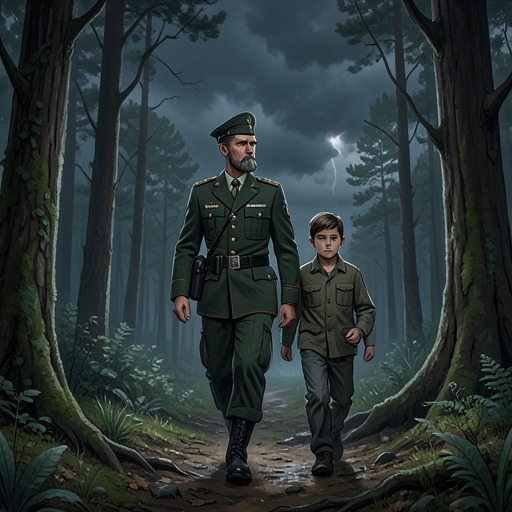
Weeks later, before sunrise on market day, The Silent One takes The unnamed boy narrator to a derelict hut near the crossing. They climb onto its roof. The Silent One lights a cigarette and gestures for the narrator to wait, without explaining why. A crowded morning train approaches, carrying peasants from the surrounding villages; baskets protrude from windows, and passengers cling to the steps. The Silent One sweats, licks his lips, brushes back his hair, and watches the train with an expression that makes him seem suddenly much older.
As the train reaches the crossing, The Silent One grips the narrator’s arm hard enough to make him jump. The locomotive veers violently aside. Only the two front cars follow it; the rest of the carriages climb over one another and tumble from the embankment. A cloud of steam hides the wreck, while screams rise from below. The narrator is stunned; The Silent One sags, watches the dust settle, then pulls him away. They return to the Children’s home while people rush toward the crash and ambulance bells ring nearby. The scene makes the switch’s earlier potential terrifyingly immediate, but withholds the decisive physical action: no movement of the lever is narrated, and the boys’ precise role in the derailment remains unshown.
In the following days, newspapers with black borders publish the names of the dead, police seek political saboteurs suspected of earlier crimes, and cranes lift carriages twisted and entangled across the track. The switch consequently stands at the juncture of private secrecy and public catastrophe. Its earlier repair supplies a concrete means by which the boys might influence a train, while the narration’s omission of the act preserves uncertainty about what happened. That gap leaves the mechanism suspended between a child’s thought experiment and a disaster with named casualties, giving the Railway Switch its lasting force as an image of power exercised without visible accountability.